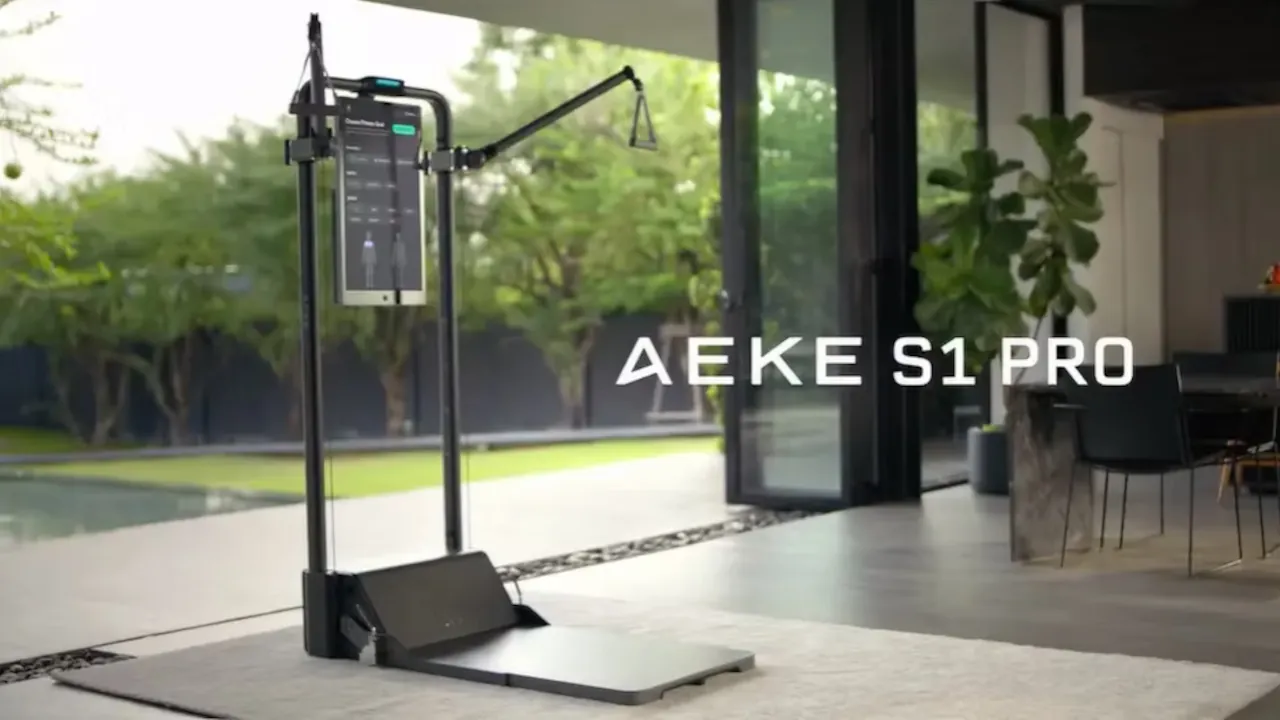
The AEKE S1 Pro is a folding cable machine with a 27-inch touchscreen, 220 pounds of digital resistance and no subscription. It raised $5.8 million from 1,885 backers on Kickstarter and is now sold directly by AEKE. Most smart gyms hook you with the hardware and then bill you every month, which is exactly the kind of expensive monthly workout subscriptions we keep warning about. This one does not. Here is what it costs, what you get for the money and where it falls short.
AEKE S1 Pro at a glance
- Price $3,999 at AEKE (list price $4,599)
- Monthly fee None
- Resistance 220 lb in total, 110 lb per arm
- Screen 27-inch tilting touchscreen
- Folded size About 28 x 17 inches of floor, 73 inches tall
- Weight 243 lb
- Warranty 2 years on the machine, 1 year on accessories
What the AEKE S1 Pro Costs
When we checked on October 9, 2026, AEKE listed the S1 Pro Complete Set at $3,999, down from a list price of $4,599, with free shipping. A bundle with the folding bench was $4,199. Prices on new fitness hardware move around a lot, so treat these as a snapshot and check the current price on the product page before you decide.
The number that matters more is the one that is missing. There is no membership. AEKE says the training content and the AI coaching are included, and that this will stay true for future programs as well. Over three years, a rival machine with a $40 to $60 monthly plan costs an extra $1,400 to $2,200 on top of the hardware. Here the price you pay on day one is the whole bill.
How the AI Actually Works
When we talk about artificial intelligence in fitness, it usually just means an app guessing your reps. The AEKE S1 Pro uses a built-in camera to follow 42 skeletal points on your body while you move. It watches your shoulders, hips and knees, counts your reps and scores your form as you go.
The motors do the clever part. If you start struggling to finish a heavy bicep curl, the spotter mode recognizes the slowdown and dials back the resistance so you can finish the set safely. There are six resistance modes in total: constant, concentric, eccentric, elastic, rowing and HIIT. Eccentric mode makes the lowering phase heavier than the lifting phase, which is something a normal weight stack cannot do.
One thing to know if you like devices that keep working without the cloud: the guided classes and the AI coaching need an internet connection. Without Wi-Fi the machine still works in free workout mode, so you can keep lifting, but the coaching features switch off.
Heavy Lifting in the Living Room
Smart gyms often feel flimsy when you push them hard, but this system is built around a heavy motorized cable structure. The hardware offers several clear advantages over traditional weight stacks:
- Real Resistance: You get 220 pounds in total, split as 110 pounds per arm, adjustable in 1 pound steps.
- Flexible Movement: The arms move across 185 different angles, so you can go from squats and lat pulldowns to rotational core work.
- Interactive Control: You run the whole workout from a 27-inch touchscreen that tilts to match your viewing angle.
Is 220 pounds enough? For most people training at home, yes. An early hands-on review from K Squared Fitness, written by a strength coach, found the frame sturdy and the cables smooth, and reported that chest flies at 38 pounds were already a real challenge. The same review points out the limit: if you squat or deadlift heavy with a barbell, a cable machine does not replace a rack.
Setting Up Your Space
The machine arrives fully assembled. You do not drill it into wall studs like older smart fitness screens. You roll it into place on its wheels, lock the platform and plug it in. Folded, it takes up about 3.2 square feet of floor.
Training needs more room than the folded size suggests. AEKE recommends a clear area of roughly 5 by 6 feet with a ceiling height of at least 7 feet 3 inches, so check low basement ceilings before you order. A few more practical points:
- Weight: At 243 pounds it is stable under load, but think about stairs and floors before delivery day.
- Power: It needs a properly grounded three-prong outlet.
- Light: The camera tracks best in normal indoor light. Direct sun or a dark room will confuse it.
- Fit: AEKE designs it for users between 4 feet 11 and 6 feet 7, and it stores up to nine user profiles.
Pros and Cons
Pros
- No subscription, with coaching and classes included
- Spotter and eccentric modes that free weights cannot match
- Folds to about 3.2 square feet and rolls on wheels
- Arrives assembled, with no wall mounting
- 2-year warranty on the main unit
Cons
- $3,999 is a serious upfront cost
- 220 pounds will not satisfy heavy barbell lifters
- AI coaching and classes stop without internet
- Classes and voice guidance are in English only
- AEKE is a young brand with a short track record
Who Should Buy It
The S1 Pro makes the most sense if you want a full strength setup in a spare room, garage or living room and you are tired of paying monthly for the privilege. It suits beginners and intermediate lifters especially well, because the camera feedback and the spotter mode cover the two things people training alone usually lack.
Skip it if you already own a rack and plates, if most of your training is heavy barbell work, or if the price would be a stretch. A good adjustable bench and a set of dumbbells cost a fraction of this and need no outlet.
What Happened to the Kickstarter?
The campaign is closed. It ran for 39 days and finished at $5.8 million from 1,885 backers, which made it one of the larger crowdfunding campaigns of the year. If you backed it, delivery updates come through Kickstarter. Everyone else now orders from AEKE directly, where the product page lists a 30-day return window. Read the return terms before you buy, because sending back a 243-pound machine is not a small job.
Image Credit: AEKE