
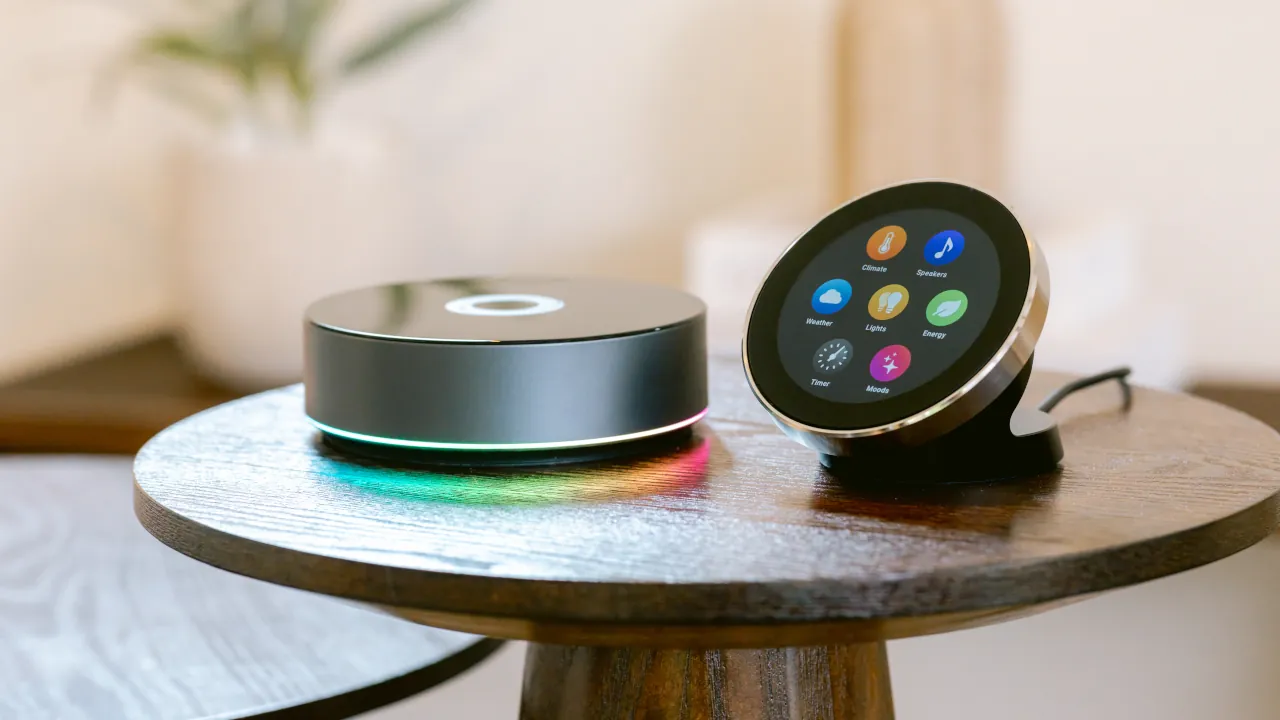
Reaching for your phone to dim the lights has always been the weakest part of the smart home pitch. Homey just announced a fix. The Homey Portal is a small round touchscreen with a metal ring around it, built to sit on a table or hang on a wall, and it gives everyone in the room a way to control the lights, music, and temperature without opening an app. It went up for pre-order in the US at $249.
What Homey Portal Actually Is
The hardware is refreshingly simple. You get a 2.8-inch round touchscreen wrapped in a stainless steel ring that physically rotates. Inside there is a quad-core ARM processor, a small speaker, a proximity sensor, and a USB-C port for power.
Every unit ships with both a desk stand and a wall mount in the box, so you decide where it lives after it arrives. No separate accessory purchase, no picking the wrong version at checkout.
This is Athom’s first product built around a physical control surface rather than an app screen. The company already sells the Homey Pro hub, and the Portal is designed as an add-on to that setup rather than a replacement for it.
How the Tap and Twist Controls Work
The interaction model is the whole point here. The ring handles anything with a range: brightness, volume, temperature. The screen handles everything else, like skipping a track or shifting a bulb to a warmer shade.
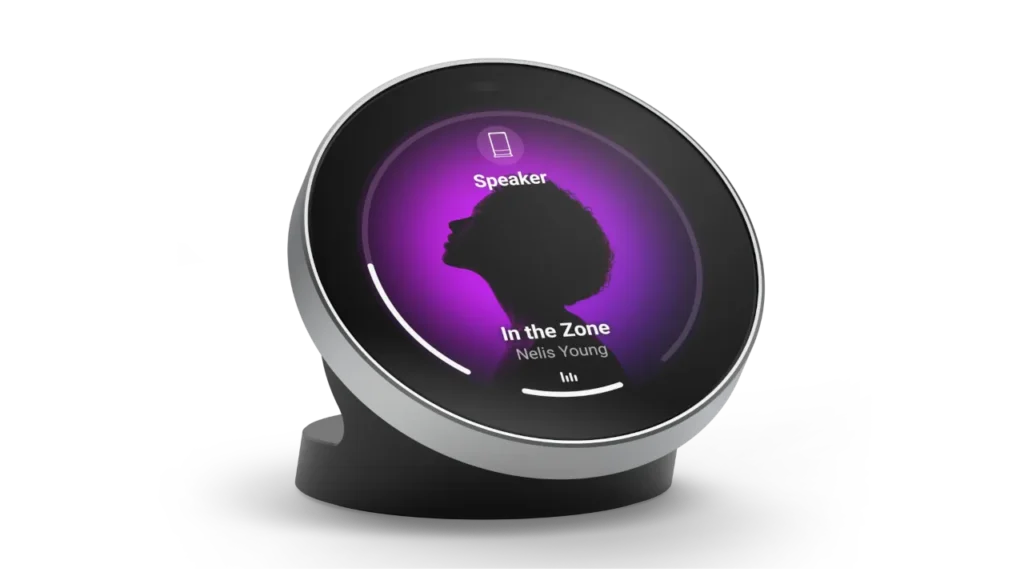
Tap the screen to switch a room’s lights on or off. Twist the ring to dim them. For climate, the display shows current temperature and humidity with color coding for heating or cooling, and a twist sets your target. For music, you get artist, track, and album art, with a twist for volume and a swipe to skip.
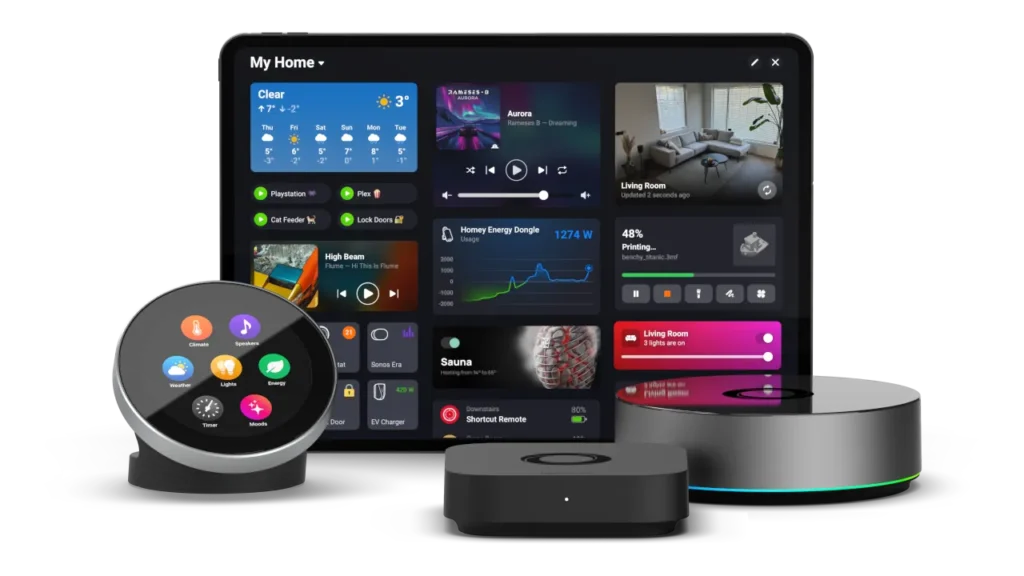
The Portal also surfaces notifications from your Homey Flows, so a reminder or a doorbell alert can appear on the screen instead of your phone. If you run a Homey Energy Dongle, the screen can display live wattage and solar production for that zone, which pairs nicely with the newer solar automation tools Homey rolled out this summer.
The appeal is that nobody needs an account or an app to use it. Your partner, your kids, and a visiting friend can all walk up and turn the lights down.
One Portal Covers One Zone
Here is the detail that shapes the buying decision. Each Portal is assigned to a single zone, such as your living room or kitchen. Once assigned, it automatically shows the devices you have already connected in that room, including any nested zones underneath it.
You can still tap through to a device elsewhere in the house, and you can pin shortcuts to any device, Flow, or Mood you want on the home screen. But the default view belongs to one room. Covering three rooms properly means buying three Portals.
That makes your zone structure worth tidying up before the unit arrives. If your rooms are half-organized or your devices carry odd names, it is worth sorting out your room grouping first so the Portal shows the right things straight away.
What You Need Before You Buy One
The Portal is not a standalone gadget. It works only inside the Homey ecosystem, and it needs one of these behind it:
- Homey Cloud, which is free for your first five devices
- Homey Pro (2023 through 2026 models)
- Homey Pro mini
- Homey Self-Hosted Server
You also need the Homey app on iOS or Android to run setup and manage shortcuts. And one clear limitation from Homey itself: the Portal cannot replace a wall thermostat, because it does not talk to your boiler directly. It controls thermostats and air conditioners that are already connected to Homey.
If you do not own any Homey hardware yet, budget accordingly. Homey Pro runs around $449, which puts a single-room setup near $700. The upside is that Homey Pro processes automations on the hub itself, so it keeps working during an internet outage, which is the same local-first approach a lot of smart home owners are moving toward.
US Price and Availability
Homey is selling the Portal in dollars, not converted euros. The introductory price is $249 for the first production run, rising to $299 afterward.
Multi-packs cut the price slightly:
- Single pack: $249
- Duo pack: $488, saving $10
- Triple pack: $727, saving $20
Pre-orders are open now through the Homey Store. Orders ship first come, first served, and Homey expects the first units to go out before the end of 2026. Pre-orders can be canceled for a full refund any time before shipping.
Apple Is Reportedly Building Something Similar
Worth a quick note for context. Apple is rumored to be working on a comparable idea, a countertop or wall-mounted home hub combining a HomePod speaker with a roughly 7-inch display, with Siri at the center and face recognition that adapts the interface to whoever walks up.
None of that is confirmed, and no price has surfaced. But the direction is telling. Two very different companies have landed on the same conclusion, which is that the phone is a poor remote control for the room you are standing in.
Who This Is Actually For
The Portal makes sense if you already run Homey and you have hit the point where your automations are good but your household still cannot use them without you. It is a control surface for people who did not build the system.
It makes far less sense as a first smart home purchase. Between the hub and the Portal, the entry cost is steep, and the device does nothing outside the Homey ecosystem. If you are on Alexa, Google Home, or Apple Home, this is not an option at any price.
For existing Homey owners, though, $249 for a wall-mounted room controller that needs zero configuration is a reasonable ask. Just remember it covers one room at a time.
Source: Homey
Image Credit: Athom